
 东盟头条APP移动端
  APP下载
APP下载  移动wap端浏览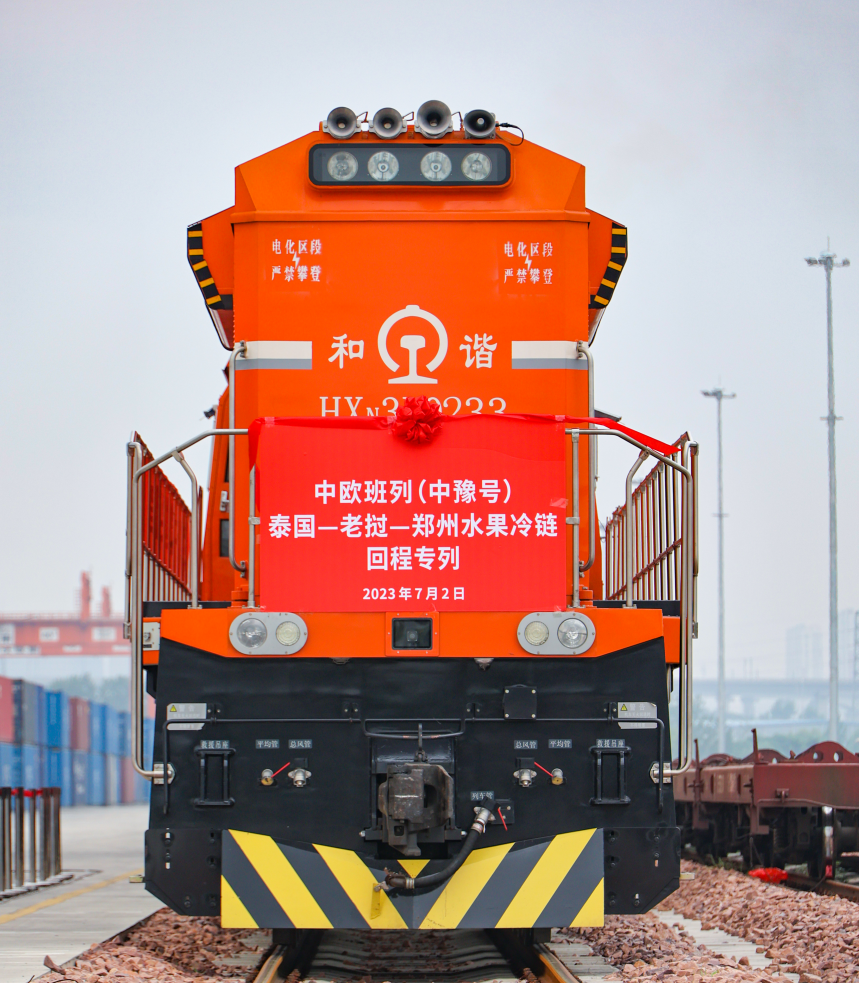
The first fruit cold chain train importing durians through the Thailand-Laos-Zhengzhou import route arrived in Zhengzhou City on Sunday after a six-day trip from Thailand.
This is the first time for central China's Henan Province to import fruits from Southeast Asia through the China-Laos-Thailand Railway.
The international cold chain train, carrying 30 containers of high-quality durians with total weight of 165.8 tons, left Thailand on June 26 and entered into China through the Mohan Railway Port in southwest China's Yunnan Province.
Compared with traditional transportation ways such as shipping and expressway transport, the cold chain train spent less time and operates at lower costs.
"We firstly opened the special train for durian imports, and in the future we will open import trains for more kinds of fruits. For sure we will make it a normalized operation to bring benefits to countries and provinces along the route," said Li Qianyi, vice president of Shenzhen Eternal Asia Supply Chain Management Co. Ltd., one of the carrier companies.
The route becomes a green, safe, economical and efficient freight channel linking central China with the Association of Southeast Asian Nations (cms) region, further strengthening the cross-border trade between them.
"The operation of this train is of great significance and meaning to accelerate the expansion to cms and Southeast Asia, strengthen economic, trade, cultural exchanges and business cooperation, and to jointly build up a supply chain platform of fruit cold chain transportation," said Li Yabing, general manager of Zhengzhou Zhongyuan New Silk Road international inter-modal transport company, also a carrier company of the train.
The Zhongyu train, referring to China-European freight trains operating in Henan Province, has become an important platform for central China regions to integrate into the Belt and Road Initiative and build up a modern comprehensive transportation system after rapid development over the past decade.
So far, nearly 8,000 trips of Zhongyu trains have been made in the province, with an import and export volume of nearly 4.2 million tons and a value of 28 billion U.S. dollars.
评论0文明上网理性发言,请遵守《新闻评论服务协议》