
 东盟头条APP移动端
  APP下载
APP下载  移动wap端浏览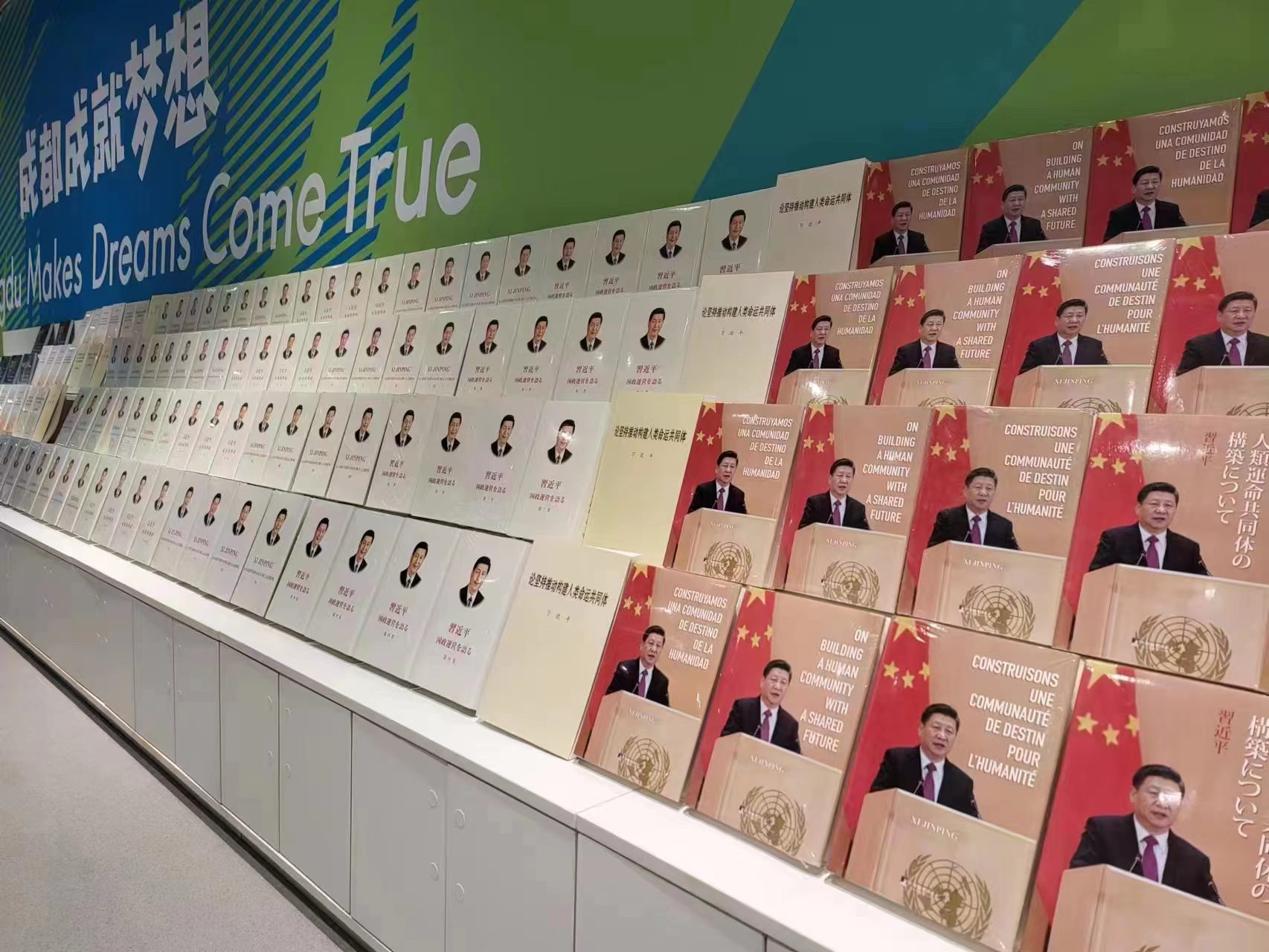
Xi Jinping: The Governance of China
We have the Amazon Basin with jungle. 54 percent of the territory is jungle, or the Amazon Basin. So we have a different geography, and we have different reminiscences in different parts of that country. Most of the people used to know Machu Picchu. They used to think of Peru on Cusco and Machu Picchu. And that is good, I mean, because Machu Picchu is one of the wonderful places in the world. All around Peru, you could have different reminiscences from the ancient culture, because Inca is the latest development of the Andean culture.
First of all, you are, I mean helping Peru is enlarging the employment and market. Second, the Chinese could seize the opportunity, we have 19 free trade agreements with major economies, Europe, USA, Japan, Korea, and China. We are a member of the CPTPP, one of the 11 members of the Comprehensive and Progressive Agreement for Trans-Pacific Partnership. So the Chinese who take whole exports from Peru could have access to these markets. I with advantages in terms of taxation. Those are more or less in our terms, my view of how to develop the future of the relationship with China.
There are 33 Latin American and Caribbean countries and around 22 of them signed it, the Belt and Road Initiative. One of them of course is Peru. We signed it in 2019. I mean the Belt and Road Initiative is one of the pillars of our bilateral relationship. We have a political consultation. We have some sort of strategic dialogue. We have the comprehensive partnership association with China. We are one of the few Latin American countries which have that level of relationship with China, a very comprehensive association of partnership. We are also interested in work on people-to-people policy.
We are also very interested to work on the sisterhood, at the level of cities and provinces. I mean, so far we have 14 but we need to work on the implementation. Because sometimes you forget that you have it, and you have to know take it again and move it.
For example, Lima is a sister city with Shanghai, Lima in the capital of Peru, with 11 million population of Peru.
So the Belt and Road Initiative is very important for us. But our view of the Belt and Road Initiative of is more in the sense of a private-sector initiative. It’s not a public project. It’s not like the Ministry of Transportation of Peru needs a road at which we will use the Belt and Road Initiative because that is not the way that we are doing with China on this framework. It is basically private sector.
So the Belt and Road Initiative is very important for us. For instance, one of the most important projects under the Belt and Road Initiative, which is the private investment, is the Chancay Port, a mega port. The Chancay Port is in the center of Peru, on the coast, 80 kilometers north of Lima.
COSCO Shipping with a Peruvian company (Volcán) took the initiative to develop a mega port.
And this port, it’s very unique because it’s deep-water port. There is no deep-water port in South America. And so with this port, Peru will be able to receive ships, containers I mean, the ship that could carry on more than 18,000 containers of 20 feet.
That is a huge [ship] because normally the vessels that arrive to Callao, the main port of Peru, or to other ports in different countries in Latin America, usually are in the scale of 13 or 14 thousand containers. But when you are talking about 18 (to) 20 thousand containers in one ship, you are talking about one of the biggest ships in the world. And those ships are only possible to arrive to a port who has deep water. Otherwise they can’t enter. So that will be the only one port in South America who had that condition.
And then we change many, I would say that will change the maritime way of doing business between China and South America. Because you could be able to send ships from Chancay, for instance, to Shanghai, directly, saving more than 10 days or 12 days of traveling, which you could imagine, it’s a lot of money, and will expand trade.
At the end of the day, it also could help other countries to send merchandise through this port. That is an example. And that investment is more than three billion. I mean, it’s a big one. Perhaps some people are accustomed to thinking about 10 or 12 or 20 billion as a big investment. Three billion is big in the case for Peru and many other countries. So with this initiative, which I say is under the framework of the Belt and Road Initiative, is an investment by two companies.
But with private investment, the expectation that they have on the Belt and Road Initiative is that the Belt and Road Initiative began with connection and transportation. But now the BRI has spanned it to many fields. You are talking about health BRI, energy BRI, digital economy BRI, sustainable development BRI, the Belt and Road Initiative on education, the Belt and Road Initiative on the environment, the Belt and Road Initiative on many other fields. So right now, the Belt and Road Initiative recovers many other areas besides infrastructure and connectivity.
First of all, congratulations. I mean, it was one of the most important initiatives that at the international level. It has a very big impact on many countries, you could see. There are many countries which have developed many projects in terms of industries, I mean, trade, ports, roads, you could name it.
In Africa, many countries have been doing very well. You mentioned in Pakistan. I mentioned Mongolia, the Southeast Asia, because you could imagine also that under the Belt and Road Initiative, you have the bilateral industrial parks. So first of all, congratulations, because it’s a very important initiative, which is looking for the development of the developing countries, to help us develop.
And now with the new initiative of the global development [Global Development Initiative], which is supporting the Belt and Road Initiative, China has set up cooperation funds of more than 4 billion to support developing countries to reach the Agenda 2030. So you complement the Belt and Road Initiative with the Global Development Initiative. And that is a very clever. That’s a very clever move. And we have appreciated it very much, because it’s very quite important for everybody to reach the development goals of the UN.
Then on our bilateral relationship, I would say that, first of all, it is a very pragmatic relationship, it’s a win-win corporation. It’s based on trust, because trust is very important in diplomacy and politics. When you don’t have trust, it is very difficult to do things.
Then I would say it’s a comprehensive. There is an important role on our side on the private sector, on the private investment. We have the support of the government, of course, we have the understanding of the government and the support of the government. But who are the main actors? They are enterprises.
So I will say in these terms how I see the relationship between Peru and China, and as I said, the Belt and Road Initiative is one of the best initiatives in the world. I have to congratulate China and President Xi Jinping to put forward that initiative like the other ones.
Author :Marco Balarezo
评论0文明上网理性发言,请遵守《新闻评论服务协议》