
 东盟头条APP移动端
  APP下载
APP下载  移动wap端浏览
 An industrial chain extending from the rice fields is weaving Cambodia's agricultural traditions and China's technological innovations into a picture of common prosperity.
On June 3, 2025, in the rice fields of Otasek Village, Kampong Chhnang Province, Cambodia, a special groundbreaking ceremony was held. The China-Cambodia "Rice-Fish Corridor" Guangxi Modern Rice Industry Cooperation Project was launched here, marking a new stage of comprehensive advancement in agricultural cooperation between the two countries. Just two months later, Cambodian durians were air-freighted directly to the Chinese market for the first time, adding a new channel for the tropical country's agricultural product exports.
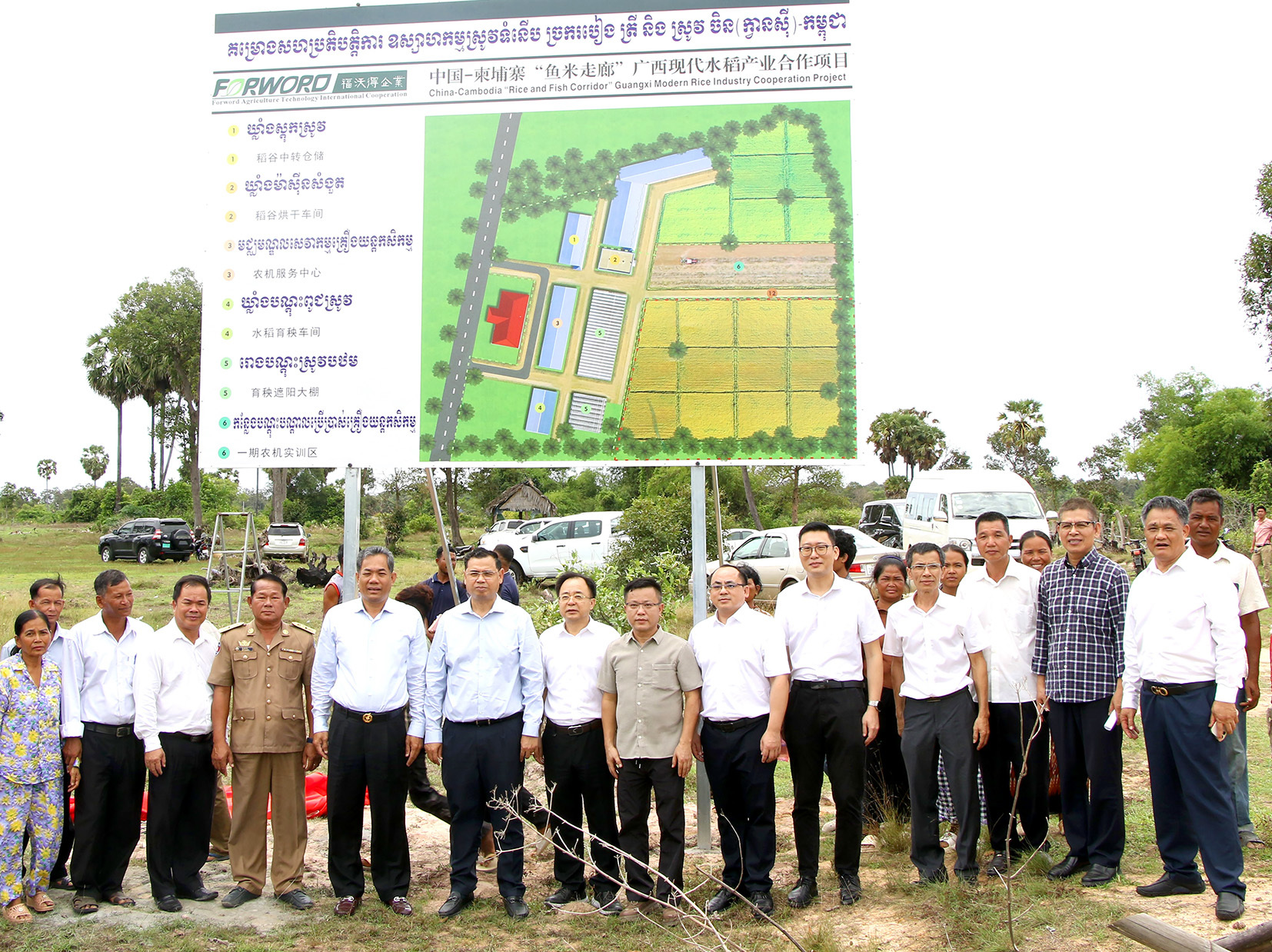
Image Source:Department of Agriculture and Rural Affairs of Guangxi Zhuang Autonomous Region
As the rolling rice fields and modern processing plants complement each other, the "Rice-Fish Corridor" has transformed from a concept into reality. With technological innovation, talent cultivation, and industrial upgrading as its pillars, this corridor is reshaping the fundamentals of Cambodia's agricultural development.
Rice-Fish Symbiosis: A Quiet Agricultural Revolution Nurtured by Science and Technology Courtyards
In the rice-fish demonstration base of Prey Chorngeak Village, Takeo Province, a quiet agricultural revolution is underway. At the Cambodia Rice-Fish Science and Technology Courtyard, graduate students from Shanghai Ocean University are guiding local farmers to adjust the stocking density of giant river prawns. This 5-hectare demonstration base, established by Shanghai Ocean University in 2021 (including 2 hectares of rice fields and 3 hectares of ponds), has become a key technical support point for the national strategy of "China-Cambodia Joint Construction of the Rice-Fish Corridor".
In response to Cambodia's warm and humid climate, the Science and Technology Courtyard has innovatively developed two models: "rice-giant river prawn symbiosis" and "rice-giant river prawn rotation", and formulated detailed technical regulations. The promotion of these technologies has achieved remarkable results - they have been adopted by 20 farmers, covering an area of 22.4 hectares.
Local farmers were initially skeptical of the new technologies until demonstration households reaped substantial benefits through practice. A single breeding season (4-5 months) can generate an income of 3,000 US dollars, and the large, plump giant river prawns have become a signature dish in nearby tourist restaurants. Seeing the actual results, farmers have taken the initiative to learn the new technologies. "Training one demonstration household can drive ten neighboring households," said 维拉博胡 (Virak Bohu), a Cambodian international student at Shanghai Ocean University, explaining the multiplier effect of technology diffusion. The Science and Technology Courtyard has also compiled a Khmer version of the Rice-Fish Cultivation Technology Manual, with 250 copies printed and distributed to local farmers. Additionally, 6 technical training sessions have been held, benefiting 210 people.
Technology Empowerment: Extending the Industrial Chain to Create High Added Value
In the Guangxi Modern Rice Industry Cooperation Zone in Kampong Chhnang Province, a complete industrial chain is taking shape. The project has innovatively proposed the "1234" work promotion plan: constructing a 70-hectare core demonstration area; carrying out demonstration area construction and capacity improvement; establishing three centers for seedling raising, agricultural machinery, and drying & storage; and conducting four types of technical training.
"The supporting construction of modern storage and processing facilities will be carried out to build an integrated industrial chain model covering planting, processing, and sales," the project leader stated. The Guangxi team has not only brought advanced rice planting technologies and management experience but also focused on cultivating local agricultural professionals in Cambodia.
Beyond rice, the extension of the value chain for aquatic products is equally important. In May 2025, Professor Sun Xiulan, Dean of the School of Food Science and Technology at Jiangnan University, led a team to conduct on-site investigations in Cambodian fish sauce and cashew processing enterprises to address their development challenges. At the technical exchange meeting, in response to the technical bottlenecks raised by the enterprises, Sun Xiulan explained the innovative achievements of Jiangnan University in processing technology upgrading, quality and safety control, and new product research and development, and put forward customized solutions. Three months later, a delegation from Jiangnan University visited Cambodia again and held in-depth discussions with institutions such as the Royal University of Agriculture of Cambodia on key technical issues including improving fish sauce brewing quality, extending the shelf life of soybean drinks, and preserving nut raw materials. After conducting on-site inspections of several food enterprises, the delegation provided feasible suggestions on production process optimization and the replacement of automated equipment, laying the foundation for the joint construction of the Phnom Penh Branch of the Jiangnan University Technology Transfer Center.
Talent as the Foundation: Educational Cooperation to Cultivate Local Forces
In July 2025, at Duanhua University in Phnom Penh, a group of Cambodian young people were learning rice factory-style seedling raising technology. The outstanding among them will have the opportunity to pursue further studies at Shanghai Ocean University through the "Lancang-Mekong Rice-Fish Scholarship". Since its establishment in 2021, this scholarship has enrolled 2-3 international students from Lancang-Mekong countries each year, with priority given to students from Cambodia and Laos. To date, it has cultivated 6 professionals in the field of rice-fish farming.
Educational cooperation has been continuously deepened. The project team from Shanghai Ocean University has visited Cambodian high schools to introduce the development prospects of the "Cambodia Rice-Fish Project" to teachers and students of the graduating class. The International Student Office has provided detailed explanations of the enrollment policies, and He Zizhen, a Cambodian international student, shared his study experience in Shanghai, encouraging his compatriots to study advanced agricultural technologies in China.
In March 2025, Cui Pengwei, Secretary of the Party Leadership Group of the Chinese Academy of Tropical Agricultural Sciences, and the Director of the Cambodian Rubber Research Institute jointly unveiled the plaque to launch the "Overseas Tropical Agricultural Science and Technology Center (Cambodia)", expanding cooperation to more tropical crops such as natural rubber, bananas, and cashews. This center will strengthen joint research, personnel exchanges, and skill training, promote the upgrading of the value chain of Cambodia's tropical crop industry, and serve the construction of the "Rice-Fish Corridor".
Poverty Alleviation and Income Increase: The Shared Prosperity Practice of Plentiful Rice and Fat Fish
At the demonstration site in Takeo Province, farmer Thorn was busy harvesting giant river prawns from the rice fields. "In the past, we relied on the weather for a living and fished for wild fry during the rainy season, with unstable harvests," he admitted. "Now, having learned scientific aquaculture, my income has quadrupled." This transformation is the most direct poverty alleviation effect of the "Rice-Fish Corridor".
Cambodia has a rice planting area of 3.3 million hectares, but freshwater pond aquaculture accounts for only 1,350 hectares, indicating huge potential for integrated rice-fish cultivation. Tesomony, Director of the Aquaculture Department of the Cambodian Ministry of Agriculture, Forestry and Fisheries, commented: "The Chinese team knows how to formulate policies based on local conditions and has helped Cambodia expand the long-term development path of agriculture."
The upgrading of the cashew industry has provided another example of poverty alleviation. Cambodia has a cashew planting area of approximately 700,000 hectares, with an annual output of 800,000 to 1 million tons. However, it has long mainly exported raw cashews. In 2025, the Cashew Agricultural Industrial Park in Kampong Thom Province will be put into operation. The processing plant built by CSNC has an annual processing capacity of 12,000 tons, and its products will be directly exported to Hainan, China for the first time. This means that more processing links will remain in Cambodia, creating more jobs and added value.
In the rice fields, giant river prawns shuttle beneath the rice seedlings; in the processing plants, the cashew automatic production lines are about to start; in the laboratories, experts from Jiangnan University and Cambodian technical personnel are jointly optimizing the fish sauce formula. From the "1234" rice plan in Kampong Chhnang to the rice-prawn symbiosis technology in Takeo Province, from the food processing seminars in Phnom Penh to the cashew industrial park in Kampong Thom Province, the "Rice-Fish Corridor" is expanding from a single agricultural product trade to in-depth integration of technology, talents, and industrial chains.
Along this corridor, graduate students from Shanghai Ocean University work side by side with Cambodian farmers in the fields; food scientists from Jiangnan University solve technical problems in factories in Phnom Penh; and agricultural technology experts from Guangxi teach seedling raising technologies in Kampong Chhnang. When Cambodian cashews fly directly to Hainan next year and giant river prawns become a delicacy on Khmer dining tables, the wisdom of the two ancient civilizations has found a new resonance in the era of plentiful rice and fat fish.
评论0文明上网理性发言,请遵守《新闻评论服务协议》